How Auto Body Shops Match Paint After an Accident
QUICKANSWER: Auto body shops match paint after an accident by scanning the vehicle's existing color with an electronic color-reading tool, cross-checking that reading against the manufacturer's paint code, and mixing a formula that accounts for how the original paint has faded over time. Technicians then spray the mixed color onto a test card and compare it to the car under more than one type of light, since metallic and pearl finishes can look matched in the shop and off once the car is outside. Once the formula holds up, the new paint is blended into the panels next to the repair rather than stopped at a hard edge, so there is no visible line where old paint meets new. The goal is a repair that a buyer, an inspector, or the vehicle's own owner cannot point to.
A freshly repaired fender can look flawless under a body shop's overhead lights and still turn heads for the wrong reason the moment it rolls out into direct sun. That gap between "matches in the shop" and "matches outside" is the entire reason paint matching is treated as a process, not a guess. Getting a repaired panel to disappear into the rest of the car takes more than pulling a can off a shelf. It takes reading the color that's actually on the vehicle in front of the technician, not just the code printed on a sticker, then proving that match under more than one kind of light before a single panel gets sprayed.
At Piperformance, an Impact Collision Center serving Raleigh, North Carolina since 2002, that process runs the same way on every repair, whether it's one scuffed bumper or a full panel repaint. Here's what actually happens between the moment a damaged car arrives and the moment it leaves looking whole again.
Why the Code on the Sticker Isn't the Whole Story
Every vehicle has a manufacturer paint code, usually printed on a plate somewhere in the door jamb or under the hood. It would be convenient if a shop could just look up that code, mix the formula, and spray. In practice, the code is only a starting point.
Sun And Weather Change The Color Over Time
Carolina summers are hard on a finish. UV exposure fades pigment, humidity works at the clear coat, and years of road grime dull the shine. A car that's been parked outside for a decade rarely looks like the color it rolled off the line with, even though the sticker in the door jamb never changed.
Paint Batches Vary
The same paint code can come out slightly different between production runs, plants, and model years. Two cars built a year apart with the identical code printed on them can read as two different shades side by side.
One Panel Can Age Differently Than Another
A hood that catches direct sun all day fades faster than a door that sits in shadow half the time. That means the "right" color for a repair isn't always the factory formula. It's whatever that specific panel looks like today.
Because of all this, a shop that only matches to the printed code is setting itself up for a repair that looks close in the garage and wrong in the driveway.
Reading the Color That's Actually on the Car
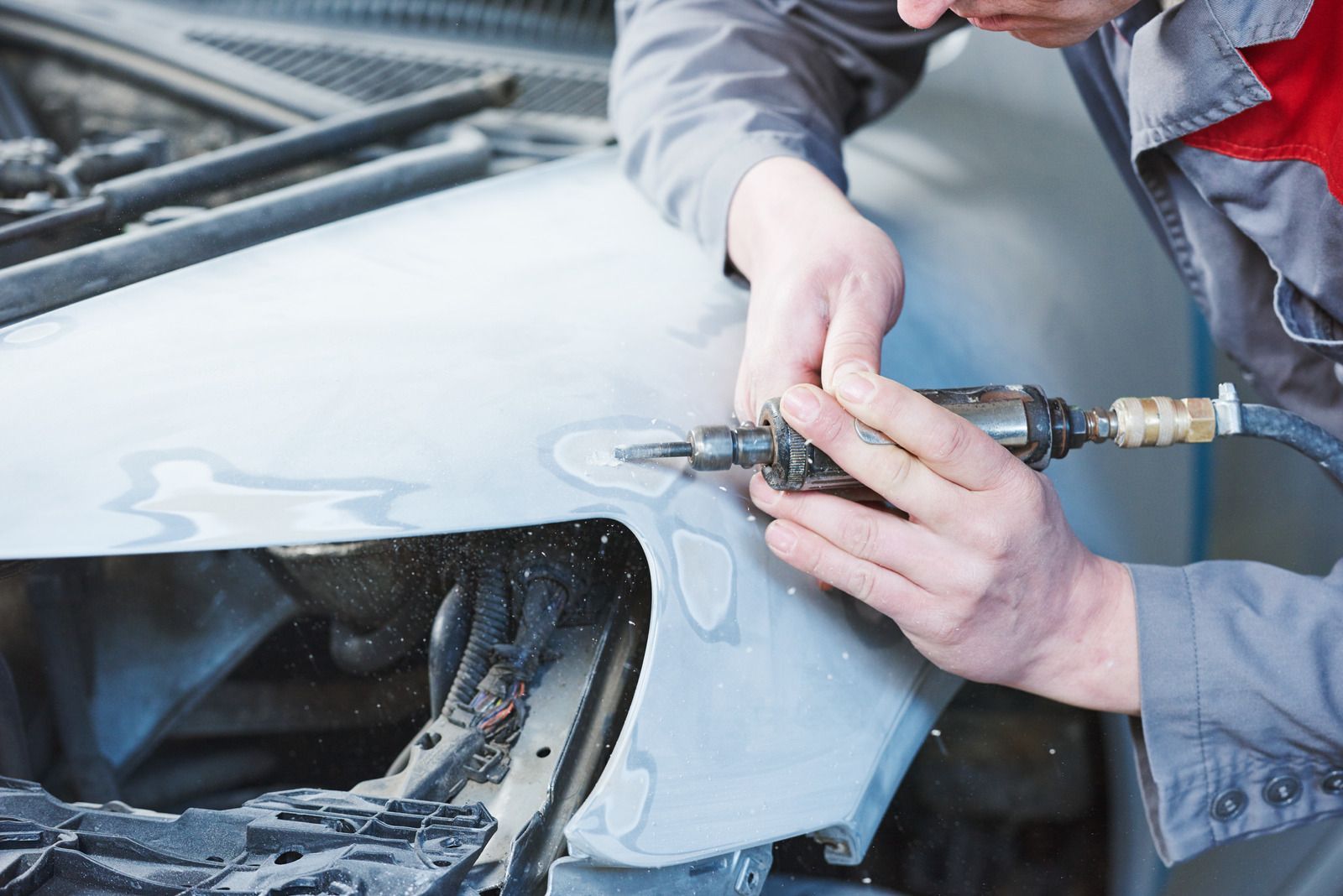
Before any paint gets mixed, a technician reads the panel next to the damage with an electronic color-measuring tool. This device measures how light reflects off the surface across a range of wavelengths and compares that reading against a database of known formulas tied to the vehicle's paint code and its common fade variants.
A clean, undamaged section of the panel matters here. Dirt, wax, or a chalky, oxidized layer on old paint will throw off the reading, since the tool ends up measuring the degraded surface instead of the true color underneath it. On older or heavily sun-worn vehicles, a technician will often polish a small test spot first to cut through that oxidation before taking a reading, so the formula gets built from the real color and not a faded version of it.
Mixing the Formula and Proving It on a Test Card
The scan produces a starting formula, but no painter sprays that formula straight onto a customer's car. It goes onto a spray-out card first, applied with the same gun settings and technique planned for the actual repair.
That card is then compared to the vehicle under more than one kind of light. This step exists because of a phenomenon called metamerism, where two colors can look identical under one light source and different under another. A color that matches perfectly under a shop's fluorescent lighting can shift and look slightly off once the car sits under direct sun. Checking the card indoors and outdoors, and sometimes in shade as well, is what catches a mismatch before it ever reaches the vehicle. If the card doesn't hold up across all three, the formula gets adjusted and a new card gets sprayed and rechecked until it does.
Metallic and Pearl Finishes Take Extra Work
Solid colors are the most forgiving to match. Metallic and pearl finishes are a different challenge, because they contain tiny reflective flakes that shift the way the color appears depending on the angle it's viewed from, an effect painters call flop.
If a technician sprays with too much or too little air pressure, or holds the gun at an inconsistent distance from the panel, those flakes settle at a different orientation than the factory finish. The result can be a repair that matches when viewed head on and looks noticeably lighter or darker from the side. Consistent gun distance, speed, and pressure across every pass are what keep the flake orientation lined up with the rest of the car.
Tri-coat pearl finishes add another layer of complexity. These systems build the final color out of three separate layers: a ground coat that carries the base hue, a mid-coat that carries the pearl or shifting effect, and a clear coat on top. Each layer has to be built up and checked on its own, since the number of coats and the speed of application directly affect how warm or cool the finished pearl effect looks.
Blending New Paint Into the Panels Next to It
Even a properly matched formula can sit slightly differently against an older, weathered panel right beside it. That's the reason shops don't stop new paint at a hard line along the edge of the damaged panel. Instead, the color is faded, or blended, gradually into the neighboring panel so the transition disappears rather than announcing itself.
On tri-coat and pearl repairs, that blend gets extended in stages. The ground coat might blend onto the first adjacent panel, the mid-coat extends a little further onto the panel past that, and the clear coat extends further still. Offsetting where each layer stops is what keeps the eye from ever finding a single edge where the repair begins.
TIP: When picking up a repaired vehicle, walk around it outside in daylight before you leave the lot. A shop confident in the match will encourage you to check the panel in natural light, not just under the shop's own lighting.
Checking the Finish Before the Car Leaves
The last step is the same comparison used on the test card, now applied to the finished vehicle. A technician looks at the repaired panel under the shop's lighting, then outside in direct daylight, and often in shade as well, since a mismatch that stays hidden indoors is usually the first thing a customer notices once the car is parked outside. This is also where a controlled spray booth earns its keep. Spraying and curing paint in a space where humidity and temperature stay consistent removes one more variable that could throw off the color or the texture of the finish before the car ever leaves the shop.
At Piperformance, every repair goes through this same read, mix, test, blend, and check process, and every finish carries a lifetime warranty behind it. Over 25 years of doing this work in Raleigh, North Carolina has made one thing clear: the difference between a repair that disappears and one that doesn't almost always comes down to how much testing happens before the spray gun ever fires.
Frequently Asked Questions
Why doesn't my car's paint code guarantee a perfect match?
A paint code reflects the formula used at the factory, not how that color looks on your car today. Years of sun, weather, and normal wear change the finish, so the printed code is a starting point that still has to be checked against the actual panel.
What is metamerism and why does it matter for a repair?
Metamerism is when two paint colors appear to match under one light source but look different under another, such as matching under shop lighting and then looking off once the car is outside. Testing a mixed color under more than one type of light is how a shop catches this before it becomes visible on the finished vehicle.
Are metallic and pearl paint colors harder to match than solid colors?
Yes. Metallic and pearl finishes contain reflective flakes that shift how the color looks depending on the viewing angle, an effect known as flop. Matching these finishes takes more careful, consistent spray technique than a solid color requires.
Why do technicians blend paint into the panels next to the repair instead of just the damaged panel?
Blending fades the new color gradually into the surrounding factory finish instead of stopping at a hard edge, which is what keeps a repair from standing out even up close. Without it, even a well matched color can read slightly differently next to older, weathered paint.
How can I tell if a repair was color matched correctly?
Look at the repaired panel outdoors in natural daylight, from a few different angles, not just straight on under the shop's lighting. A properly matched and blended repair should hold up the same way in the sun that it did inside the shop.
Does the age of my vehicle affect how well new paint will match?
It can. Older vehicles have had more time to fade or develop a chalky, oxidized surface, which changes how the color reads and can throw off a scan if the surface isn't addressed first. A technician accounts for this by reading the true color beneath any surface wear before a formula is ever mixed.
The Difference Between a Repair and a Disappearance
A repair is only finished when it stops looking like one, when the panel reads exactly like the rest of the car in the parking lot, in the driveway, and under the sun at three in the afternoon. That result is not luck, nor a can of paint pulled off a shelf. It comes from reading the true color first, proving the formula on a test card under real light, and respecting what metallic and pearl finishes demand before a single pass gets sprayed.
Piperformance, an Impact Collision Center serving Raleigh, NC, has built that habit into every job for 25
years, treating each blend and each test card as the difference between a car that looks fixed and one that simply looks like itself again. Done right, nobody standing beside the vehicle has reason to guess which panel was damaged. The color holds under every light it meets, and what's left behind is a car that matches itself, panel to panel, without a single seam to find.